A ceiling fan runs in almost every Pakistani home all summer, and loadshedding is when you miss it most. An ordinary AC fan runs only on mains power, or through a UPS. An AC/DC fan runs on mains power and can also run straight from a battery or a solar setup. These are our current fan prices:
| Product | Price (PKR) |
|---|---|
| Fan ROYAL | Rs.10,500 |
| Khurshid Fan AC/DC | Rs.12,520 |
AC fan or AC/DC fan: what's the difference?
- AC ceiling fan: runs on the 220V mains supply. During loadshedding it needs a UPS or a generator. Most older fans in Pakistani homes are this type.
- AC/DC ceiling fan: runs on mains power, and also on DC from a battery or solar panels. During a power cut it can keep running from the battery without a UPS.
Why that matters: a UPS turns the battery's DC into AC for an AC fan, and some energy is lost in that conversion. A fan running on DC straight from the battery skips that step, so the same battery lasts longer.
We stock the Khurshid AC/DC fan and the Royal Deluxe ceiling fan.
How long will a battery run the fan?
You need two numbers: the energy the battery stores and the power the fan draws.
- Battery energy in watt-hours = battery voltage × capacity in amp-hours. A 12V 100Ah battery stores about 1,200 Wh.
- Usable energy: don't drain a battery flat. Lead-acid batteries last longer if you use only about half, so count on roughly 600 Wh from that 12V 100Ah battery. Lithium batteries allow more; check the maker's figure.
- Hours = usable watt-hours ÷ the fan's watts.
For example, a fan drawing 40 W runs for about 15 hours on 600 Wh. Two such fans on the same battery run about half as long. The fan's wattage is on its label; ask us the figure for any fan we sell.
Shop · fan
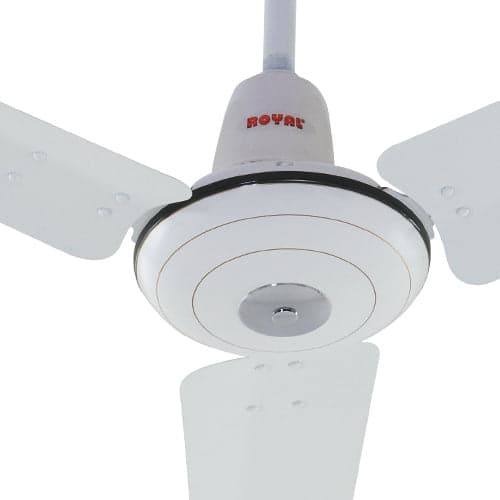
Fan ROYAL
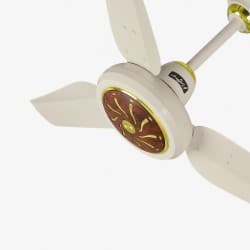
Choosing a ceiling fan
- Sweep: ceiling fans are sized by sweep, the distance from one blade tip to the opposite one. A bigger sweep moves air over a bigger area. Ask us the sweep of a model before ordering.
- Height: the blades should be well above head height. In a low room, a short downrod keeps them clear.
- Speed control: check how the fan's speed is controlled and what comes in the box.
Looking after a ceiling fan
- Hums but turns slowly, or needs a push to start: on an AC fan, the capacitor is a common cause. It's a cheap part an electrician can change.
- Wobbles: check that every blade is tight and none is bent. Uneven blades shake the fan.
- Dust: wipe the blades every few weeks in summer; dust builds up along their leading edge.
- Low voltage also slows fans. Our voltage protector guide explains what low and high voltage do to appliances.
Installing a ceiling fan
- Hang the fan from a strong ceiling hook made for a fan, not from a light fitting.
- Have an electrician connect it through a switch and regulator, and earth it.
- For an AC/DC fan, the battery or solar connection needs cable of the right size and a fuse near the battery.
Running a solar setup? Keep the panels clean with our solar panel cleaning guide.