A ball valve and a gate valve both shut off water, but they work differently. A ball valve opens and closes with a quarter turn of a lever, so it's quick, and you can see at a glance whether it's open. A gate valve opens and closes with several turns of a wheel, which is slower but closes gently. On a house water line either one will cut off the water; the choice comes down to where it's fitted and how it connects to the pipe.
How a ball valve works
Inside is a ball with a hole through it. Turn the lever 90° and the hole lines up with the pipe, so water flows. Turn it back and the solid side of the ball blocks the pipe.
- Opens and closes in a quarter turn.
- The lever shows its position: in line with the pipe means open, across the pipe means closed.
- Seals well when closed.
- Household ball valves are usually brass with threaded ends, so they join PPR pipe through threaded fittings.
How a gate valve works
Turning the wheel raises or lowers a flat gate (a wedge) across the pipe. Fully open, the gate is out of the way and water flows straight through.
- Takes several turns to open or close, so it can't be slammed shut.
- Closing slowly avoids the sudden pressure surge (water hammer) that a fast-closing valve can cause on a long line.
- You can't tell from the outside whether it's open or closed.
- A valve that's never turned can stiffen over the years, so open and close it fully now and then.
Our Popular gate valve is a PPR valve: it fuses straight into a PPR line like any other fitting, with no threads.
Shop · gate valve
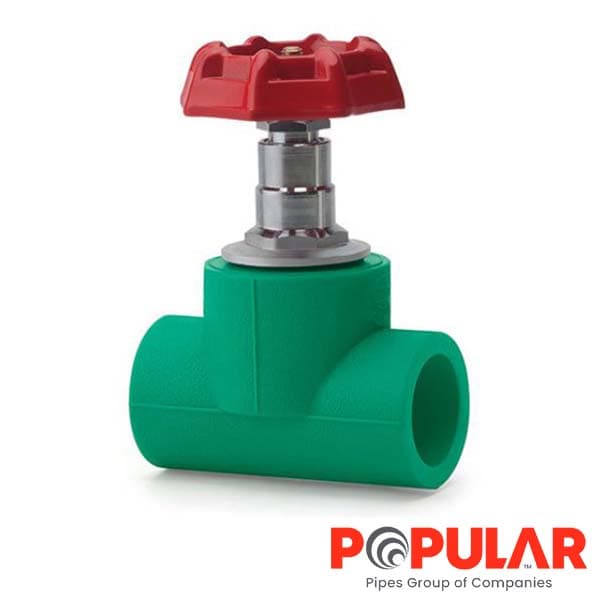
Ball valve vs gate valve: side by side
| Ball valve | Gate valve | |
|---|---|---|
| How it's operated | Quarter turn of a lever | Several turns of a wheel |
| Speed | Instant on and off | Slow |
| Open or closed at a glance | Yes, from the lever | No |
| Shock when closed on a long line | Can cause water hammer if snapped shut | Gentle |
| Joining to PPR pipe | Usually threaded brass | A PPR gate valve fuses in directly |
| Left half-open to control flow | Not meant for it | Not meant for it |
Neither valve is made to be left half-open to control the flow. Both are meant to be fully open or fully closed, and running them half-open wears the seal.
Where to fit valves in a house
- At the roof tank outlet, so the house can be shut off without draining the tank.
- On each bathroom and the kitchen line, so one bathroom can be repaired while the rest of the house has water.
- On both sides of the pump, so it can be taken off for repair.
- Before the geyser, to shut it off for servicing.
- Before a washing machine or a water filter.
A common approach is a gate valve on the main line from the tank, where it's set once and left alone, and ball valves at points you shut more often or may need to close fast, such as under a sink or before a washing machine.
Connecting valves to PPR pipe
- PPR gate valve: fuse it in place, just like a socket.
- Threaded ball valve: fuse a threaded PPR fitting onto the pipe on each side and screw the valve between them, with PTFE tape on the threads. Use male threaded fittings for a valve with female threads, and the other way round. Fit a union nearby so the valve can be replaced later.
The PPR pipe and fittings guide explains each threaded fitting. We stock KITZ, RUB and Hero ball valves alongside the Popular PPR gate valve, all under sanitary products.
For where these valves sit in the whole system, see how a house water system works. Changing a tap after you've shut the valve? The bathroom fittings guide covers what to buy.