
Most Pakistani homes use a water pump, usually just called the motor, for one of two jobs: lifting water from an underground tank or the mains up to the roof tank, or raising the pressure at the taps and showers. Which job you need done decides which pump to buy. These are our current prices for pumps and the parts that run and protect them:
| Product | Price (PKR) |
|---|---|
| Digital Power Protector The Voltage Moniter | Rs.950 |
| Float Switch | Rs.1,200Rs.1,300 |
| Automatic pressure Switch Controller ESPA | Rs.6,500 |
| Water Pump | Rs.18,000 |
| Water pump Espa | Rs.65,000 |
Not sure which pump suits your house? Send us the details on WhatsApp (see the tip below) and we'll suggest one.
Lift pump or pressure pump: which job is yours?
Lifting water to the roof tank. When the mains supply comes, or from an underground tank, a pump pushes the water up to the overhead tank. From there it runs down to the house by gravity. This is the most common setup. The pump needs enough head to reach the roof (see below), and a float switch can run it automatically.
Boosting pressure at the taps. A roof tank gives weak pressure on the top floor, because the tank sits only a little higher than the showers there. A pressure pump on the line from the tank, usually with an automatic pressure controller, gives strong flow at the top-floor taps and showers.
Many houses have both.
Head and flow: the two numbers that matter
A pump's plate or box lists two main figures:
- Head (metres): how high the pump can push water. The maximum head is the height at which the flow drops to zero, so pick a pump whose maximum head is well above the height you need, with allowance for the pipe length and bends.
- Flow (litres per minute): how much water it moves. More flow fills a tank faster or feeds more taps at once.
The two trade off: the higher a pump has to push, the less water it delivers. The pump's performance chart shows the flow at each height.
To estimate the height you need, measure from the water level in the lower tank (or the mains point) to the top of the roof tank. Each floor of a typical house adds roughly 3 to 3.5 metres.
Power is listed in HP or kW. A bigger motor isn't always better: a pump far bigger than the job uses more electricity than it needs to.
Shop · water pump
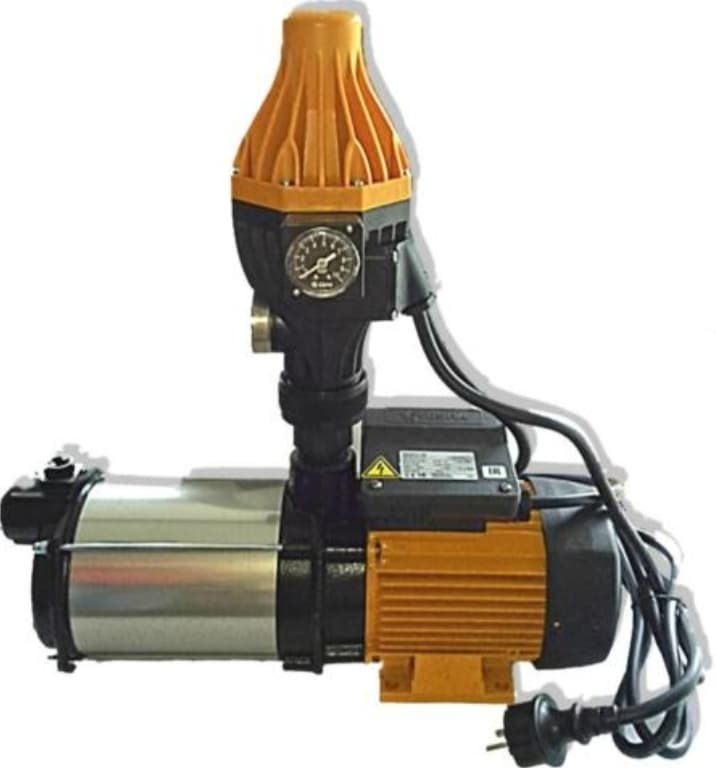
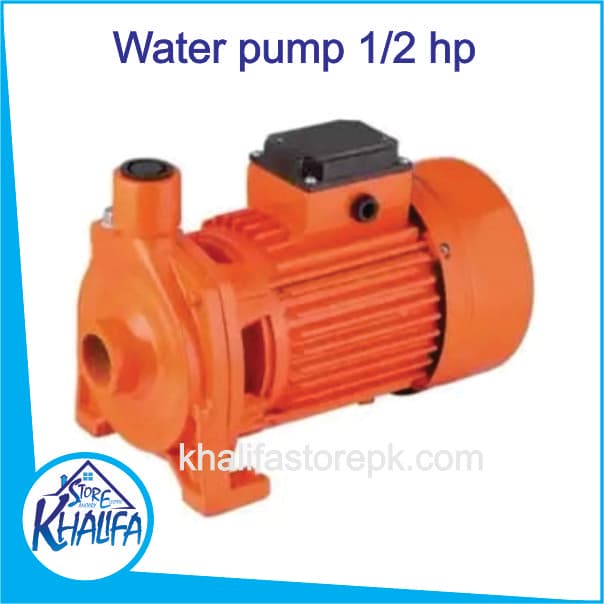
Water Pump
What an automatic pressure controller does
An automatic pressure controller (also sold as a pressure switch or flow controller) fits on the pump outlet. When you open a tap, the pressure in the line drops and the controller starts the pump. When you close the tap and the flow stops, it switches the pump off. Nobody has to switch the motor on and off for every shower.
Many controllers also stop the pump when water stops reaching it, which protects it from running dry. Features differ between models, so check before relying on it. We stock the ESPA automatic pressure controller, and the ESPA brand page lists everything we have from ESPA.
Never let the pump run dry
The water passing through a pump cools its seal and impeller. Running without water, even for a few minutes, can overheat and damage them. The usual causes are the lower tank running empty, the mains supply stopping, or air getting into the suction pipe.
Ways to prevent it:
- A float switch in the roof tank that stops the pump when the tank is full, and one in the lower tank that stops it when the water there runs low. See the float switch guide.
- A pressure controller with dry-run protection, on a pressure system.
- A non-return (foot) valve at the bottom of the suction pipe, so the pump stays primed between runs.
Shop · float switch, power protector

Float Switch

Protect the motor from voltage swings
High and low voltage both strain an electric motor. A voltage protector between the socket and the pump cuts the power when the voltage goes outside a safe range, and restores it once the supply settles. Check that the protector's current rating covers your pump, and ask us if you're not sure. Our voltage protector guide explains the settings. We stock a digital power protector.
Make sure the pump is earthed, and that its cable and switch are sized for the motor.
Installing the pump: a checklist
- Fit the pump on a firm, level base close to the lower tank, so the suction pipe is short.
- Keep it under a cover, out of rain and direct sun, with air around the motor.
- Put a union and a valve on each side, so the pump can be taken off for repair without cutting pipes.
- Prime the pump (fill the casing and the suction pipe with water) before the first start, as its manual says.
- Use the pipe size the pump's inlet and outlet are made for. A narrower pipe cuts the flow.
For the pipes and valves around the pump, see the PPR pipe and fittings guide and ball valve vs gate valve. For where the pump sits in the whole system, see how a house water system works.


